
Martyrs Day July 5 is a national observance honoring those who gave their lives in the struggle for civil rights and racial justice; and calling Americans to confront the truth about freedom and its cost.
A contemporary reimagining of Frederick Douglass’ iconic speech on July 5, 1852—transposed to July 5, 2026, carrying forward his moral clarity into today’s sociopolitical reality.
America’s Forgotten Women
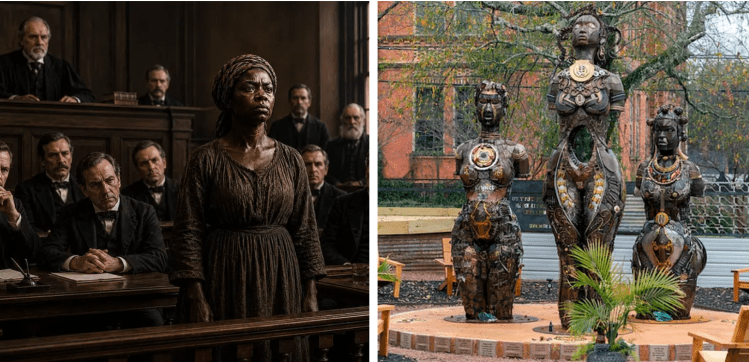
Who owns your body? Can you decide what happens to it? Can you protect it? Can you refuse? Can you say no? For millions of enslaved Africans and their descendants, the answer was a resounding, “No!” Nowhere was this denial more visible than in the lives of Black women.
If July 5th is to become a true day of remembrance, then we must remember not only those who died in public acts of resistance, but also those whose lives expose the hidden architecture of oppression. Among them are four names America rarely speaks together: Celia (one of the martyrs honored on MartyrsDay.us/profiles), Betsy, Anarcha, and Lucy.
Their stories are different. Yet they reveal the same truth. Freedom begins with ownership of one’s own body. And America denied them that freedom.
Celia: The Crime Before the Crime
Celia was borne into slavery around 1835. At approximately fourteen years old she was purchased by Missouri farmer Robert Newsom in 1850. She was not purchased as a daughter. Not as a worker. Not as a citizen. Not as a human. She was purchased as property.
What happened next was not unusual for enslaved women. Shortly after buying her, Newsom began repeatedly raping her. For years Celia endured violence that was fully protected by law. The legal system recognized Newsom’s rights. The law offered Celia no protection because it did not recognize her as human nor did it recognize her bodily autonomy. The law simply recognized property and white male authority.
The nation that celebrated liberty every July 4th provided no mechanism for an enslaved girl to protect her own body. America proclaimed freedom. Celia experienced ownership. America celebrated independence. Celia experienced domination. America spoke of rights. Celia had none.
Then, in 1855, everything changed. After years of abuse, Newsom again came to claim access to her body. This time Celia resisted. She struck him. The blow killed him. For the first time in years, she exercised authority over her own body. And for that, the state condemned her.
The Trial That Revealed the Truth. Celia’s defense argued that Missouri law allowed women to defend themselves against sexual assault. The argument seemed straightforward. If a woman is attacked, she has the right to resist. But the court rejected the argument. Not because Celia had not been assaulted. Not because the violence was in dispute.
According Missouri law in 1855, it was a crime “to take any woman unlawfully against her will and by force, menace, or duress, compel her to be defiled.” A homicide committed while warding off such a crime against one’s person was justifiable.
The court rejected the argument because it refused to recognize Celia as fully entitled to the protections granted to women. The law protected women—but not those enslaved. The legal question was never whether Celia had been violated. The legal question was whether someone considered property could claim the rights of a human being. The answer was no. Celia was convicted and executed in 1855.
The Body as Property
To understand Celia’s story, we must first understand something larger than Celia herself. Her experience was not an exception. It was a system. A worldview. A social order built upon ownership of Black bodies. This worldview reached beyond plantations and courtrooms. It also entered medicine. And there, three other women would experience a different form of violation.
Betsy, Anarcha, and Lucy
Around the same period that Celia fought for control of her own body in Missouri, three enslaved women in Alabama were enduring another struggle.
Their names—Betsy, Anarcha, and Lucy. Artist Michell Browder remembers the women. History does not. History remembers the physician. J. Marion Sims is often called the “Father of Modern Gynecology.” Medical textbooks frequently celebrate his innovations. Less frequently discussed is how those innovations were developed.
Sims performed repeated experimental surgeries on enslaved Black women suffering from fistulas caused by difficult childbirth. The women were subjected to procedures without anesthesia. Anarcha reportedly endured dozens of operations.
The women could not freely leave. They could not meaningfully consent. They existed within a system that gave others authority over their bodies. The justification differed from Celia’s experience. Yet, the underlying worldview did not.
Different Violence. Same Logic.
At first glance, the stories appear unrelated. Celia endured sexual violence. Betsy, Anarcha, and Lucy endured medical experimentation. Yet beneath both stories lies the same foundational questions: Who owns the body? Who decides what happens to it? Whose pain matters? Whose suffering is acceptable if others benefit?
For Celia, the answer was an enslaver. For Betsy, Anarcha, and Lucy, the answer was a physician. In both cases, Black women were denied bodily autonomy; their humanity was subordinated to someone else’s interests; and America advanced while they paid the price. Therein lies an apparent contradiction.
The Contradiction Frederick Douglass Saw
Frederick Douglass understood this contradiction. In 1852, just three years before Celia’s execution, he delivered his famous speech asking:
“What to the Slave Is the Fourth of July?”
Douglass recognized that America’s greatest contradiction was not merely slavery itself. It was the simultaneous celebration of liberty and denial of humanity. Celia’s life exposed that contradiction. Betsy, Anarcha, and Lucy exposed that contradiction. Their stories reveal that the issue was never merely slave labor. The issue was ownership. And ownership required the denial of autonomy.
The Battlefield of Freedom
Today, when people discuss freedom, they often focus on elections, laws, economics, or public policy. Those things matter, obviously. But freedom begins somewhere even more fundamental. Freedom begins with the body.
The question of liberty is not simply, “Can I vote?” The more fundamental questions are: Can I govern myself? Can I protect myself? Can I decide what happens to my body? Can I refuse? Can I be recognized as fully human?
For Celia, the answer was no. For Betsy, Anarcha, and Lucy, the answer was no. And because the answer was no, America cannot fully understand freedom without fully accepting their humanity.
Why Mention Them on Martyrs Day?
Some may hesitate to call these women martyrs. They did not lead marches. They did not deliver speeches. They did not become national icons. Yet martyrdom is not merely about public leadership. It is about lives that expose uncomfortable truths. Martyrdom is also about witness.
Celia witnessed against a legal system that protected ownership over bodily autonomy and human dignity. Betsy, Anarcha, and Lucy witnessed against a medical system willing to advance through exploitation. Their lives reveal what America often prefers to forget: Progress has costs.The question is who pays them. And whether those costs are remembered.
I mention them as a deeply human examination of freedom through the lives of women whose bodies became battlegrounds in America’s unfinished struggle for liberty.
JOIN US ON MARTYRS DAY JULY 5: FIND AN EVENT TO EXPERIENCE THE FULL STORY!
Reflection Ethos
- Why do you believe Celia, Betsy, Anarcha, and Lucy remain largely absent from public memory?
- How does bodily autonomy shape your understanding of freedom?
- What responsibilities come with remembering difficult history?
- How did slavery depend upon the denial of bodily autonomy?
- What parallels exist between historical and contemporary struggles over bodily control?
- Why do societies often celebrate progress while forgetting those who paid its costs?
- What would it look like for America to fully honor the lives of women like Celia, Betsy, Anarcha, and Lucy?

