
Martyrs Day July 5 is a national observance honoring those who gave their lives in the struggle for civil rights and racial justice; and calling Americans to confront the truth about freedom and its cost.
A contemporary reimagining of Frederick Douglass’ iconic speech on July 5, 1852—transposed to July 5, 2026, carrying forward his moral clarity into today’s sociopolitical reality.
What to the People is the Fourth of July?
July 4, 1776 Declaration of Independence:
We hold these truths to be self-evident, that all men are created equal…
September 17, 1787 Signing of the US Constitution:
”We the People of the United States, in order to form a more perfect Union, establish justice, insure domestic tranquility, provide for the common defense, promote the general welfare, and secure the blessings of liberty to ourselves and our posterity, do ordain and establish this constitution for the United States of America.”
July 5, 1852 Frederick Douglass Speech:
”What to the Slave is the Fourth of July?”
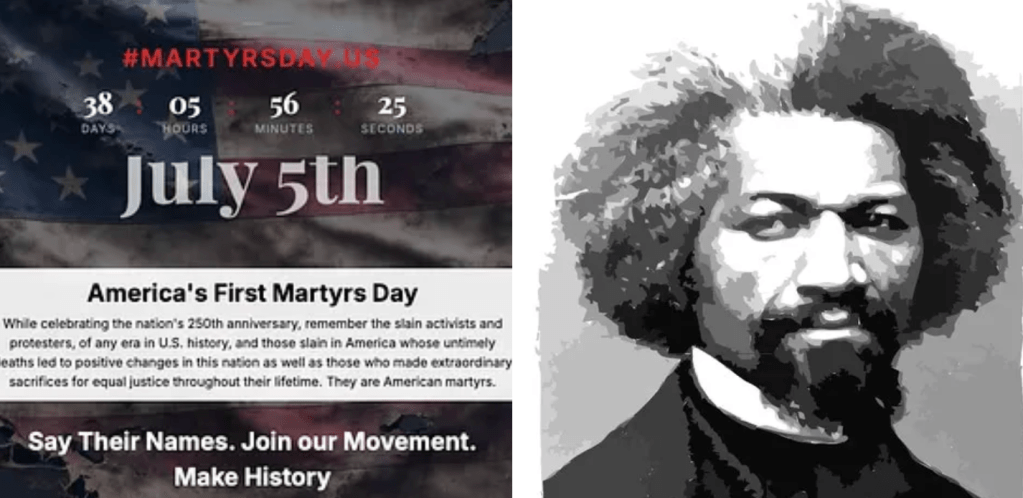
“What to the People Is the Fourth of July?”
The fireworks are gone. The flags still wave, but the smoke has settled.
And in that silence—the day after the celebration—we are left with a question that America has never fully answered: Who is freedom really for?
In 1852, Frederick Douglass stood before a largely white audience and delivered one of the most devastating moral indictments in American history:
“What to the Slave Is the Fourth of July?”
His speech shattered the illusion that patriotic celebration alone could hide national hypocrisy. While America celebrated liberty, millions of Black people remained enslaved. While the nation praised independence, it denied humanity. Douglass forced America to confront the contradiction between its declared ideals and its lived reality. More than 170 years later, the question still echoes—not because America is unchanged. But because the central tension remains unresolved.
Today, the chains are different. The systems are more sophisticated. The language is more polished. Yet the distance between the promise and the practice of democracy still defines the American experience.
And perhaps that is why the 5th of July matters more today than the 4th of July. July 4 celebrates the story America tells about itself while July 5 confronts the truth America must reckon with itself.
Patriotism or Performance
Modern America is deeply invested in symbols.
Flags. Anthems. Military flyovers. Campaign slogans. Public declarations of freedom.
But symbols are not substance. Because a nation can perform patriotism while avoiding justice. It can celebrate democracy while undermining democratic participation. It can praise equality while preserving inequality through economics, education, housing, healthcare, policing, and media narratives.
This is the crisis Douglass exposed in 1852. This is the crisis that still remains in 2026.
Today, many Americans demand “unity” without requiring truth. They seek reconciliation without accountability. They want healing without confession. But unity without truth is not reconciliation nor healing. It is choreography and performance.
Mere performance is dangerous because it allows people to feel moral without actually being moral.
The America Between Myth and Reality
America survives partly because of myth.
The myth of equal opportunity. The myth of meritocracy.
The myth that freedom naturally expands without struggle.
The myth that the nation has already overcome its original sins.
But myths become dangerous when they prevent self-examination. Frederick Douglass understood this clearly.
He recognized that America’s greatest threat was not merely slavery itself—it was the refusal of people to confront the reality of slavery while claiming to believe in liberty. It’s a contradiction that still exists today as America speaks the language of freedom while…
Restricting voting access. Criminalizing protest. Widening economic inequality.
Weaponizing fear. Censoring uncomfortable history. And concentrating wealth and power into fewer and fewer hands.
The systems may evolve. The rhetoric may modernize. But the contradiction simply rebrands itself.
The Architecture of Selective Freedom
One of the greatest illusions in America is the idea that freedom is equally experienced; that democracy is complete. It is not.
Freedom in America is shaped by race.
By economics. By geography. By education. By generational wealth. By political power.
By media representation. By who is believed and who is ignored.
For some Americans, freedom means mobility, safety, and opportunity.
For others, freedom means surviving systems never designed with them in mind.
This is another reason Douglass remains relevant. He forces us to not merely ask whether freedom exists—but to also ask who experiences it fully.
If freedom is conditional, restricted, delayed, or unequally distributed, then democracy itself remains incomplete.
The Real Meaning of July 5
July 5 is uncomfortable because it interrupts the emotional high of national celebration.
It asks:
What happens after the fireworks?
What happens after the speeches?
What happens after the slogans?
What happens when the performance ends?July 5 is where accountability begins.
Because nations are not judged by what they declare. They are judged by what they practice; not by what they celebrate—but by what they are willing to confront.
And confrontation is necessary because systems do not transform themselves.
Systems must be transformed by people. Time alone changes nothing because…
History is not automatically progressive.
Justice is not inevitable.
Democracy is not self-sustaining.
Every expansion of freedom in American history required disruption, resistance, sacrifice, and organized struggle.
Frederick Douglass and the Courage to Confront
What made Douglass extraordinary was not merely his intellect.
It was his refusal to participate in national denial. He loved the possibility of America enough to tell the truth about America. That distinction matters because critique is not hatred. Truth-telling is not division. In fact, the refusal to confront injustice is ultimately what destroys nations. Silence corrodes democracy. Comfort protects oppression. Performance delays transformation. Douglass understood that patriotism without moral courage is an empty vessel.
The greatest act of moral courage in America is the willingness to demand it to become better.
The Fifth of July and the Reimagine We Lens
In the Reimagine We framework, the deeper issue is worldview.
America’s crisis is not merely political. It is formative. The nation continues to wrestle with competing visions of humanity itself. One worldview says: power belongs to the few, history belongs to the dominant, and freedom is a possession to protect not share. Another worldview says: human dignity is collective, justice is inseparable from truth, and freedom is meaningless unless it expands for everyone.
This is not merely a policy conflict. It is a battle over imagination—a battle over memory, narrative, and who counts as fully human.
Every individual decides for themselves which worldview they will nourish and carry.
Reimagine the Future
The future of this nation will not be determined by what Americans celebrate.
It will be determined by what America is willing to confront. Will America continue to choose myth over memory? Performance over truth? Comfort over justice?
Or will it finally embrace the difficult work of becoming what it has always claimed to be? That question hangs over this nation on every 5th of July. Perhaps that’s why the words of Frederick Douglass still resonate—not as a relic of the past but as a warning to the present and a challenge to the future.
Until freedom is experienced by all, America’s independence remains incomplete.
Reflection Ethos
What national myths have most shaped your understanding of America?
Where do you see the greatest gap between America’s ideals and its reality?
What does genuine patriotism require beyond celebration?

