
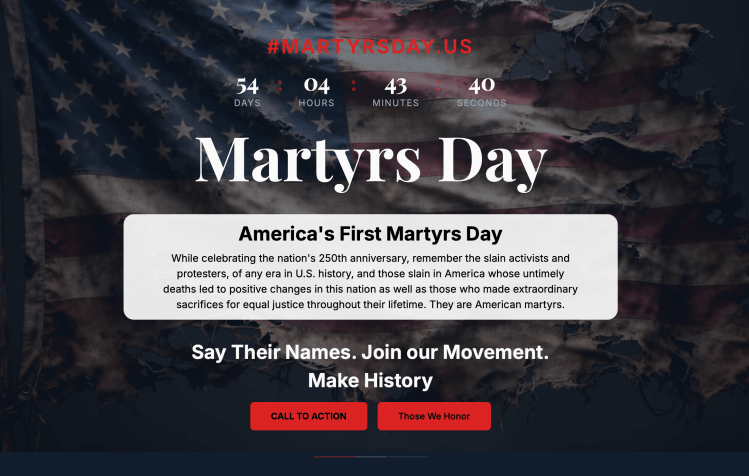
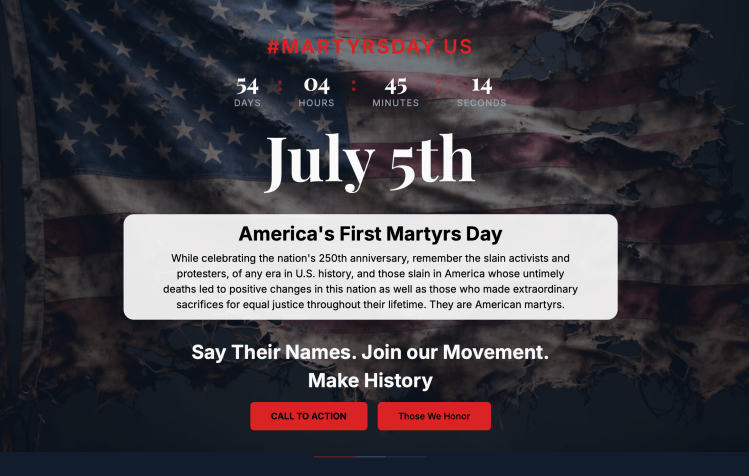
Martyrs Day July 5 is a national observance honoring those who gave their lives in the struggle for civil rights and racial justice; and calling Americans to confront the truth about freedom and its cost.
Food for Thought: What Could America Gain from a Martyrs Day Observation on July 5, 2026?
What Americans Could Gain Most Is Historical Honesty By….
Creating Space to Remember
Not only military sacrifice, but also people killed in the struggle against slavery, racial terror, colonization, labor exploitation, and political oppression. That kind of observance can challenge the habit of celebrating national greatness without grappling with national cost.
Strengthening Civic Humility
Countries and communities often use remembrance days to connect identity with sacrifice rather than with triumph alone. Public rituals matter because they shape what a nation teaches itself to honor. In the U.S., that could push people to ask: Who paid the price for the freedoms we enjoy? Who was erased from the story? Public rituals matter because they shape what a nation teaches itself to honor.
Providing Moral Clarity
Remembering martyrs can help distinguish between celebrity and courage, popularity and principle. It reminds people that social progress is rarely free; a lesson that is especially relevant in a polarized culture where convenience often outweighs conviction.
Gaining Political Education
A well-designed Martyrs Day would give schools, faith communities, and civic organizations a yearly opportunity to teach stories of resistance, conscience, and collective responsibility. In practice, that could deepen public understanding of abolitionists, civil rights workers, labor organizers, Indigenous defenders, journalists, and others whose sacrifice is often fragmented across curricula rather than held together as part of one national moral tradition.
Fostering Deeper Reflection
The most powerful version of Martyrs Day would not be a spectacle. It would be a day of reflection, truth-telling, and recommitment. The point would not just be to admire the dead, but to ask what the living now owe one other.
So, the real gain could be this…
Americans just might become less addicted to the myth of patriotism and more committed to historical accuracy. And history, when it is truthful, can become a foundation for social justice.
America’s 250th Anniversary: July 4, 2026
The official U.S. 250th anniversary centers on July 4, 2026, the 250th anniversary of the Declaration of Independence. Both the congressionally backed America250 effort and White House “Freedom 250” materials frame it as a national milestone of commemoration, celebration, reflection, and future vision.
America’s First Martyrs Day July 5, 2026
On July 5, 1852, a speech by Frederick Douglass, “What to the Slave Is the Fourth of July?”, challenged the nation to confront the truth behind its celebration of freedom. We continue that call.
“Fellow-citizens; above your national, tumultuous joy, I hear the mournful wail of millions! whose chains, heavy and grievous yesterday, are, to-day, rendered more intolerable by the jubilee shouts that reach them.” — Frederick Douglass
This celebration date carries real symbolic weight precisely because it comes immediately after the Independence Day celebration. It says—Independence should not only be praised. As the Douglass speech points out, it should also be interrogated.
So, why is it necessary to interrogate independence?
It’s necessary because the Power of Memory recognizes that…
Freedom has a cost. We remember those who paid it.
After the fireworks and the patriotic ritual, the nation is tasked to reckon with the price of freedom; who was denied it; and who died trying to widen it.
Here are five reasons for interrogation:
First, it would complete the story.
While July 4 highlights declaration, ideals, and nationhood, July 5 highlights sacrifice, contradiction, and unfinished struggle. In that sense, July 5 becomes the moral counterweight to July 4: not anti-America, but anti-amnesia.
Second, it would expose the gap between proclaimed liberty and lived liberty.
The Declaration of Independence announced freedom in 1776, but that freedom was not equally extended to enslaved Africans, Indigenous peoples, women, poor laborers, or many others. Martyrs Day July 5 forces the country to ask not only, “What was declared?” but also, “Who paid for those words of declaration with their lives?”
Third, it would move the 250th celebration from spectacle to maturity. The official anniversary language already includes reflection on the nation’s past. A July 6 observance could deepen that reflection by centering those whose blood, courage, and moral witness pushed the country closer to its own stated ideals.
Fourth, it would widen the definition of patriotism. In a Martyrs Day frame, the nation would honor not only soldiers, but also freedom fighters, abolitionists, civil rights workers, labor organizers, truth tellers, and everyday people who suffered or died resisting oppression. That would redefine patriotism as not merely loyalty to the state, but loyalty to justice.
Fifth, it would create a ritual of national repentance and recommitment. July 4 says, “We were born.” July 5 asks, “What kind of people have we become—and what kind must we yet become?” That is especially significant at 250 years because anniversaries are not just for memory; they are for evaluation.
So the significance of Martyrs Day July 5 is this:
July 4 celebrates the promise.
July 5 evaluates the cost.
“Martyrs Day July 5th honors the brave Americans who gave their lives in the struggle for civil rights and racial justice.” —Gloria J. Browne Marshall
Law Professor, Attorney, and Author, Gloria J. Browne Marshall Creates Martyrs Day to Honor Protest Deaths

The constitutional law professor, attorney, and author announced the creation of Martyrs Day, a national day of remembrance set for July 5, 2026. The observance is intended to honor protesters and activists who lost their lives in the struggle for social justice and equality in the United States. Browne-Marshall is calling the inaugural date a starting point, with plans for the observance to continue annually on July 5th going forward.

